The MEMA Vision Conference 2026 brought together hundreds of industry leaders on April 15 at The Henry Hotel in Dearborn, Michigan. Across sessions on economic pressure, AI strategy, product data quality, and leadership, the MEMA Vision Conference made one point clear: the aftermarket is growing, but the rules for winning are changing fast.
Below are six takeaways from the MEMA Vision Conference that matter most for aftermarket suppliers, brands, and channel partners planning for the next phase of growth.

What the MEMA Vision Conference revealed about the aftermarket outlook
The conference opened with the perennially popular “3 Dragons” panel, bringing together three distinct perspectives on the aftermarket’s trajectory: economics, Wall Street, and retail analytics. Moderated by Treanor Hill of Piper Sandler, the session featured Simeon Gutman (Morgan Stanley), Nathan Shipley (Circana), and Mark Strand (Cox Automotive).
Economic Outlook: Resilient but Under Pressure
Mark Strand, Deputy Chief Economist at Cox Automotive, framed the 2020s as a decade of “unabated uncertainty.” De-globalization, geopolitical instability, demographic shifts, and elevated government debt are reshaping the macro landscape.
The numbers tell a mixed story. Unemployment sits at 4.3%, near a 25-year low. However, job creation is stalling and concentrated in lower-wage sectors like healthcare and construction. Core PCE inflation is accelerating at 3.7% year over year. In addition, consumer spending is increasingly fueled by dissaving and credit rather than wage gains.
For the aftermarket, the takeaway is nuanced. Rising total cost of vehicle ownership is driving consumers to keep vehicles longer and spend more on maintenance, which is a structural tailwind. However, energy shocks and affordability pressures could still push some consumers to defer repairs. As Strand put it, “there are no crystal balls… more like a bingo card in the 2020s.”
Wall Street Perspective: Agentic Commerce Is Coming
Simeon Gutman, Managing Director at Morgan Stanley, delivered one of the MEMA Vision Conference’s most forward-looking presentations. His research projects that agentic commerce — where AI agents initiate, compare, and complete purchases on behalf of consumers — could reach 10–20% of all e-commerce by 2030. That represents $200–$400 billion in annual spend flowing through agentic channels.
Morgan Stanley’s “5 I’s” framework — Innovation, Inventory, Infrastructure, Income Statement, and Incrementality — outlines how retailers are positioning for this shift. Walmart’s OpenAI partnership and Google’s Universal Commerce Protocol signal that the largest players are already building agentic infrastructure.
For aftermarket suppliers, this changes the competitive equation. When an AI agent makes the purchasing decision, product data quality, catalog completeness, and digital availability become the factors that determine whether your part gets selected. Investing in structured, machine-readable product data today positions you to win in agentic channels tomorrow.
Retail Analytics: Growth Continues, but Watch the Shifts
Circana’s Nathan Shipley provided a data-rich snapshot of aftermarket retail performance. Aggregate unit demand has trended positive for three consecutive years, with dollar volume up 2.5% and unit volume up 0.6% in the latest period. However, the picture varies sharply by category.
Chemicals, additives, and fluids continue to grow at 3.2% in units, reflecting steady maintenance demand. By contrast, accessories and appearance products declined 3.9%, signaling that consumers are pulling back on discretionary spending. Meanwhile, Tier 3 and lower-tier tire brands are steadily gaining unit share as buyers trade down toward value offerings.
What customers said at the MEMA Vision Conference
One of the most anticipated sessions at every MEMA Vision Conference, “Talk from the Top” was presented by Emily Poladian and Ben Brucato of MEMA Aftermarket Suppliers. The session synthesized confidential interviews with major distributors and retailers, surfacing four themes the market may be underestimating:
- Technician capacity is the real constraint. Demand is there, but the ability to install and service parts is limited by a persistent workforce shortage.
- Category management and field support have not fully recovered. Post-COVID cutbacks in supplier engagement are still felt at the counter.
- Rushed diversification is introducing quality risk. Suppliers expanding too quickly into new categories are creating fitment and quality problems.
- Weak data is now a market access issue. As one distributor put it: “That data is what is selling your product… you can put yourself at a massive disadvantage if you are not on the top of your game.”

The consistency of this message is striking. As the image above shows, the 2025 MEMA Vision Conference warned that suppliers who don’t embrace business and catalog technology would be “re-sourced for lack of content.” In 2026, the message has evolved from warning to reality: data and digital capability now determine who wins the sale.
The session also named suppliers exceeding expectations — Dorman, DRiV, Standard Motor Products, Bosch, and others — cited repeatedly for strong execution, responsiveness, and genuine partnership. The fundamentals still separate winners from the field.
MEMA Vision Conference Landmark Study: Tipping Points for the Next Decade
PwC Strategy& presented the 2026 MEMA Aftermarket Suppliers Landmark Study, titled “Tipping Points: Key Shifts in the Aftermarket Over the Next 10 Years.” Presented by Shrey Mohta, Akshay Singh, and Carlos Thimann, this forward-looking analysis identified the structural shifts most likely to reshape the industry — from electrification timelines and ADAS complexity to evolving distribution models and digital transformation.
The study prioritized key trends by timing and potential impact, providing a strategic framework for suppliers to plan around disruption rather than react to it.
Voice of the End Customer: What Shops and Technicians Need
In a session brought by the MEMA Aftermarket Training Council, repair shop owners and professional technicians responded live to real-world feedback captured in professionally moderated focus groups. Featuring Philip Austin (Niterra North America), Dave Johnson (ASE), and moderated by Jim Fish (MEMA), the discussion tackled critical topics including ADAS calibration challenges, high-voltage vehicle complexity, and the growing urgency around technician recruitment and training.
For suppliers, this MEMA Vision Conference session reinforced that technology investment and training resources are no longer differentiators — they’re table stakes. The shops that can’t access training and calibration support will increasingly limit which parts they’re willing to install.
Advocacy Town Hall: REPAIR Act and Supplier Competitiveness
MEMA’s government affairs team — Ana Meuwissen and Jon Gentile — led a town hall discussion on the REPAIR Act and broader legislative efforts to increase supplier competitiveness, moderated by John Hanighen of Cloyes & Rotomasters. The Right to Repair movement continues to gain momentum, and the session highlighted how regulatory developments could reshape the aftermarket’s competitive dynamics.
Leading with Courage in an AI World
Mark Johnson, Co-Founder of Michigan Software Labs, challenged the MEMA Vision Conference audience with a provocative thesis: in the age of AI, the winners won’t be the companies with the most technical capability — they’ll be the ones with the courage to apply judgment.
The data supports the urgency. According to Johnson’s research, 93% of manufacturers have adopted AI (up from 87% last year), but 60% report minimal value despite substantial investment. Only 5% of companies are “future-built” — seeing 2x revenue impact from AI. The gap isn’t access. It’s depth of integration and willingness to redesign workflows.
To drive the point home, Johnson’s colleague David Crawford built a fully functional parts distribution mobile app — complete with barcode scanning, inventory management, and API integration — live on stage in roughly 20 minutes. Two years ago, that project would have taken two years.
Johnson’s advice: “C-suites that treat AI as an IT project will fail. C-suites that treat it as a strategy project will dominate.” Your industry knowledge, he argued, is the most important “prompt” in the room.
MiX Reverse Mentorship: What Your High-Potentials Are Really Thinking
The Modern Industry eXpertise (MiX) Council session — presented by Nico Dolcato of Dorman Products and Elisse Richardson of DRiV — brought the voice of 30 high-potential leaders across supplier companies directly to MEMA Vision Conference attendees.
The findings are worth sitting with. 54% of emerging leaders only sometimes or rarely feel comfortable raising concerns or ideas directly with senior leadership. Only 4% could clearly explain what “ready for broader responsibility” looks like in their organization.
When asked what leadership behavior most improves their ability to execute, three themes dominated: trust and autonomy, clear priorities and direction, and transparent communication. The session closed with a powerful challenge: “If your high-potential leaders answered these questions about your organization, where would their answers differ from your expectations?”
Supplier CEO Panel: Leading Through Uncertainty
The afternoon featured a panel of aftermarket CEOs — Darcy Curran (Highline Warren), Todd Hertzler (Robert Bosch), Mary Landrieu (Lisle Corporation & EZ Way), and Eric Luftig (Dorman Products) — moderated by MEMA Aftermarket Suppliers President Emily Poladian. The discussion explored how resilient leadership drives success when volatility, disruption, and shifting market dynamics define the operating environment.
Customer Keynote: Advance Auto Parts
In the members-only closing session of the MEMA Vision Conference, Shane O’Kelly, President & CEO of Advance Auto Parts, delivered the customer keynote. Advance — an $8 billion company — has been executing a significant operational transformation since O’Kelly joined in 2023, including optimizing their distribution center footprint and remodeling stores to deliver a best-in-class showroom experience.
O’Kelly emphasized that a great supplier partnership with Advance Auto Parts starts with exceptional product data and technology that streamlines connectivity. In an era where digital ordering is the norm and customers rarely pick up the phone, the suppliers who make it easy to find, validate, and order their products are the ones that earn shelf space.
PDM Automotive at the 2026 MEMA Vision Conference
PDM Automotive was proud to attend the 2026 MEMA Vision Conference as both an exhibitor and the sponsor of the closing reception. The conference reinforced what we hear from our customers every day: product data quality and seamless digital connectivity are the foundation of aftermarket success.
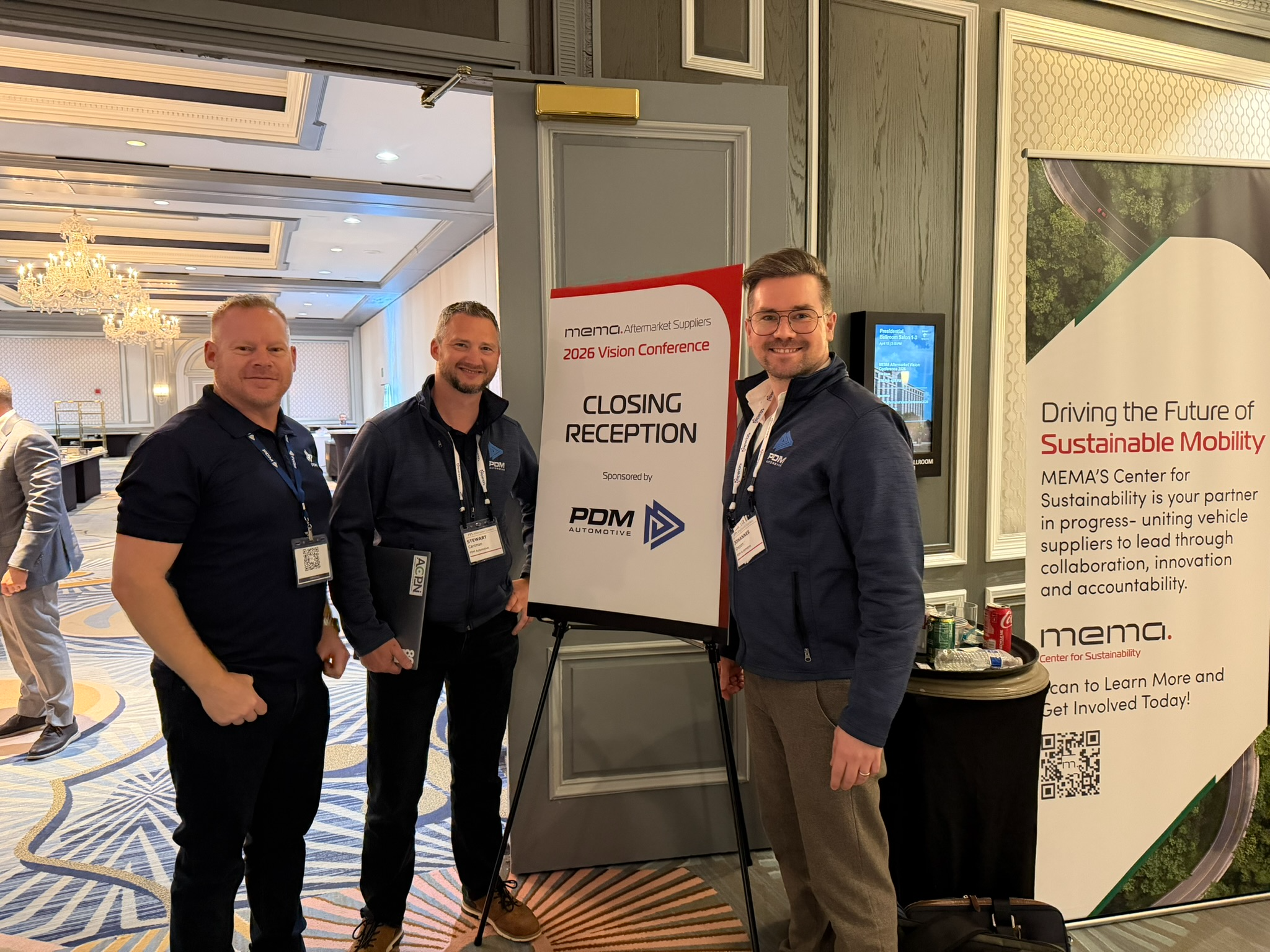
If you’re looking to strengthen your product data, improve your catalog connectivity, and position your brand for the future of aftermarket e-commerce, we’d love to connect.
What the MEMA Vision Conference means for aftermarket suppliers
The 2026 MEMA Vision Conference painted a picture of an industry at an inflection point. Demand fundamentals remain strong — aging fleets, increasing vehicle complexity, and longer ownership cycles continue to drive growth. But the competitive landscape is shifting rapidly.
Five priorities emerged clearly across every session:
- Data quality is non-negotiable. It’s no longer a back-office function — it’s a sales driver and increasingly a market access requirement.
- AI demands strategic leadership, not just IT projects. Start small, but start with intent.
- Customer relationships must be backed by execution. Fill rates, lead times, communication, and field support are the basics that separate top suppliers.
- The workforce challenge is real on both sides. Technician shortages constrain demand realization; next-gen leader development determines supplier competitiveness.
- Structural change is accelerating. Agentic commerce, ADAS complexity, and consolidation are reshaping how parts are discovered, ordered, and installed.
The aftermarket is a $287 billion industry with strong structural tailwinds. The question isn’t whether it will grow — it’s which suppliers will capture that growth.
Frequently Asked Questions
What is the MEMA Vision Conference?
The MEMA Aftermarket Suppliers Vision Conference is an annual one-day event hosted by MEMA (The Vehicle Suppliers Association). It brings together aftermarket industry leaders, analysts, and executives to discuss economic trends, technology shifts, and strategic challenges facing the automotive aftermarket.
When and where was the 2026 MEMA Vision Conference held?
The 2026 MEMA Vision Conference was held on April 15, 2026, at The Henry Hotel in Dearborn, Michigan.
What is agentic commerce and how does it affect the aftermarket?
Agentic commerce refers to AI agents that initiate, compare, and complete purchases on behalf of consumers. Morgan Stanley projects it could represent 10–20% of e-commerce by 2030. For aftermarket suppliers, product data quality and digital catalog completeness will increasingly determine which parts AI-driven purchasing systems select.
Why is product data quality becoming a market access issue?
Distributors and retailers increasingly rely on digital catalogs and online ordering. Weak or incomplete product data means your parts may not appear in search results or be selected by automated ordering systems — effectively locking you out of sales opportunities.
How are aftermarket suppliers using AI today?
According to data presented at the 2026 MEMA Vision Conference, 93% of manufacturers have adopted AI in some form, primarily in customer service (60%), inventory management (42%), and product development (36%). However, only 5% are seeing significant revenue impact, suggesting most companies need to move beyond pilot projects to deeper workflow integration.
What were the key economic concerns at the 2026 MEMA Vision Conference?
Key concerns included accelerating inflation (core PCE at 3.7%), slowing job growth, consumer spending driven by credit rather than income, and geopolitical risks including energy price shocks. For the aftermarket, these create both opportunity (longer vehicle ownership) and risk (deferred maintenance due to affordability pressure).