Automotive Catalog Data Infrastructure: Standards, Connectivity, and AI
Cataloging is no longer just a data-entry function in the automotive aftermarket. It is infrastructure that connects product data, fitment, digital assets, channel requirements, ecommerce listings, distributors, and increasingly AI-driven product discovery.
When catalog data is fragmented, teams struggle with slow updates, inconsistent listings, receiver errors, and poor visibility. When catalog data is structured and connected, it becomes easier to distribute, maintain, search, and reuse across the business.
This article explains why cataloging now needs to be treated as infrastructure, what that means for aftermarket teams, and how standards, connectivity, and AI are changing catalog operations.
Quick Answer: What Is Automotive Catalog Data Infrastructure?
Automotive catalog data infrastructure is the connected system of standards, processes, tools, and integrations used to manage product data, fitment data, digital assets, channel requirements, and distribution across the aftermarket.
Why Cataloging Is Now Infrastructure
Cataloging used to be treated as a back-office task. In the modern aftermarket, catalog data affects search visibility, ecommerce conversion, channel onboarding, distributor relationships, customer support, and AI readiness.
When catalog data is disconnected, teams spend more time fixing spreadsheets, answering receiver questions, and correcting listing problems. When cataloging is treated as infrastructure, data becomes easier to maintain, distribute, and improve.
The Three Levels of Automotive Catalog Maturity
| Level | What it looks like |
|---|---|
| Manual | Catalog data is managed in spreadsheets, email threads, and one-off exports. |
| Structured | Product, fitment, and asset data are standardized and validated before distribution. |
| Connected | Catalog data flows through integrated systems, supports multiple channels, and can be maintained continuously. |
How AI Changes Automotive Catalog Requirements
AI search and automation depend on structured, accurate, and context-rich data. If catalog data is incomplete or inconsistent, AI systems are less likely to interpret products correctly or recommend them confidently.
That makes clean product attributes, fitment context, digital assets, and channel-ready data more important — not less.
Catalog Infrastructure Checklist
- Product data is standardized across part types and categories.
- Fitment data is validated before distribution.
- Digital assets are assigned to the right SKUs.
- Channel requirements are documented and repeatable.
- Data exports can be reviewed before they reach receivers.
- Teams have a clear process for ongoing catalog maintenance.
The aftermarket industry doesn’t lack in eCommerce opportunity; it lacks coordination.
As suppliers, distributors, marketplaces, and internal teams expand across more channels, growth is increasingly constrained by disconnected data, fragmented systems, and manual processes that don’t scale. At the center of that challenge sits cataloging — not as content, but as infrastructure.
This article explores how cataloging has evolved, why traditional approaches are breaking down, and what a modern, connected catalog looks like in practice.
Want the full framework behind this perspective?
This article is based on a presentation originally delivered at the CAWA Leadership & Educational Forum.
Opportunity Exists. Coordination Is the Bottleneck.
eCommerce is no longer experimental in the aftermarket. CAWA member survey data shows roughly 45% of companies generate 1–10% of revenue online, while another 25% generate 11–25%. Demand is clearly there.
What’s holding growth back isn’t interest. It’s execution.
As companies expand across B2B portals, marketplaces, direct-to-consumer sites, and legacy ordering systems simultaneously, weaknesses in product data and coordination become impossible to ignore.
This impact can show up quickly downstream…
- Shipping errors increase.
- Returns climb.
- Warranty claims don’t align with inventory.
- ERP, PIM, and commerce platforms remain disconnected.
As a result, operations teams spend more time managing exceptions than maintaining flow. These aren’t isolated problems. They’re delayed symptoms of disconnected catalog ownership and insufficient infrastructure.
If growth feels harder than it should, the issue is rarely the channel. It’s the catalog.
This is where most teams get stuck.
In the original CAWA presentation, we break down how cataloging maturity impacts execution—and what changes when catalogs become connected infrastructure.
From Tribal Knowledge to Industry Standards
Before ACES and PIES, cataloging relied heavily on human expertise. Printed catalogs, PDFs, phone calls, and tribal knowledge filled the gaps.
This approach worked in a slower, lower-scale environment.
ACES and PIES fundamentally changed the aftermarket by standardizing vehicle fitment and product attributes. Together, they enabled digital commerce at scale and remain a critical foundation today.
But standards alone don’t address channel-specific requirements, rich content needs, continuous validation, or partner-specific interpretations. They define structure, not ongoing coordination.
Standards are essential—but they’re only the starting point.
They establish how data is exchanged, not how it’s continuously validated, adapted, and coordinated as products move across channels.
Learn what comes next.
The Three Phases of Cataloging Maturity
Cataloging has evolved through three distinct phases.
- Static cataloging relies on ACES/PIES XML files, spreadsheets, file transfers, and compliance as the finish line. It works at low scale and breaks quickly as channels multiply.
- Managed cataloging introduces structure, validation, cross-team collaboration and ownership. Chaos is reduced, but friction still appears once data leaves the system.
- Connected cataloging shifts the goal entirely. The focus moves to channel readiness, visibility into what’s live and selling, and continuous feedback loops that drive improvement.
Maturity is measured by outcomes, not files delivered.
What differentiates maturity isn’t how data is delivered—it’s whether teams can see what’s live, understand what’s working, and identify where improvement is needed across channels.
See how connected cataloging works.
The Connected Catalog as Infrastructure
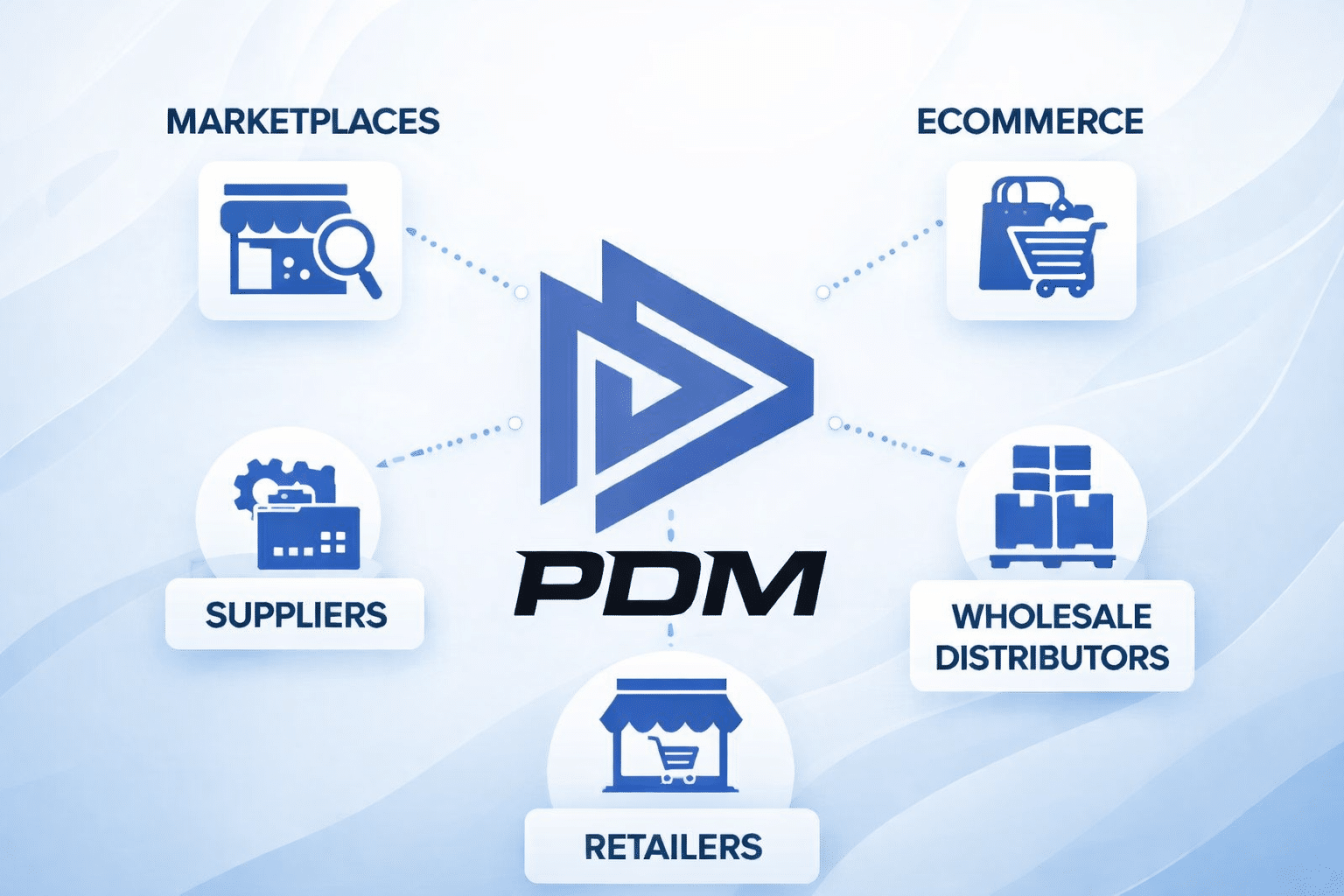
A connected catalog isn’t a single tool or database. It’s a system of systems that supports how teams actually operate.
It requires clean, normalized core data, automated channel-specific transformations, continuous monitoring of data health, and deep integration across ERP, PIM, eCommerce, marketplaces, and partner platforms.
How the catalog is used is just as important.
- Sales teams rely on accuracy to manage assortments
- Marketing teams activate products consistently
- eCommerce teams track readiness and performance
- Operations teams see fewer exceptions and returns
When cataloging is treated as shared infrastructure, it creates leverage across the business.
See the infrastructure model in action.
AI’s Role: Amplifying, Not Replacing
AI delivers value when it’s applied to the right systems.
Cataloging intelligence has evolved from rules-based automation to machine learning, and now toward agentic AI systems that can observe, act, and improve over time.
AI is most effective when it amplifies connected infrastructure, not when it operates in isolation.
When applied correctly, it:
- Surfaces issues earlier
- Reduces manual coordination
- Scales expert best practices across thousands of SKUs
Without connection, AI simply accelerates fragmentation. AI doesn’t replace structure. It rewards it.
See how AI fits into connected cataloging.
From Connected Catalog to Connected Growth
As organizations move from static files to managed systems and then to connected operations, the catalog evolves from an operational requirement into a growth platform. The Growth Partner Program (GPP) represents the next step: shared visibility, cross-functional alignment, and success measured by mutual growth — not file delivery.
When catalogs connect, growth follows.
Where the Industry Is Headed
The aftermarket’s next phase of growth depends on:
- Shared data foundations across partners
- Continuous readiness across channels
- Stronger cross-functional collaboration
- Intelligent systems that scale human expertise
The industry doesn’t have a data problem. It has a coordination problem. And cataloging is where coordination begins.
See the future model for coordinated cataloging
Final Thought
Companies that treat cataloging as infrastructure rather than content will be best positioned to scale efficiently, collaborate effectively, and grow sustainably.
If you’re deciding where to invest next, the most important question isn’t “What tools do we need?”
It’s “How well does our catalog coordinate with the business?”
Want to explore this framework in more detail?
Download the original presentation behind this article to see how connected cataloging drives coordination, visibility, and scalable growth.
Related reading
- ACES and PIES Explained
- How to Create an Automotive Parts Catalog
- Auto Parts SEO: 7 Best Practices
- Feature Spotlight: How PDM Channels Streamline Product Data Distribution
If catalog data is becoming harder to manage across standards, channels, and teams, PDM can help turn it into connected infrastructure.